A women-centered territorial approach to land restoration, water resilience and local value creation
In Northern Senegal, between the Senegal River Valley and the Ferlo drylands, LDN Advisory and IPAR are exploring an integrated Land Degradation Neutrality project designed to regenerate land, structure local value chains and support women as key drivers of territorial development.
This is not a conventional agricultural investment. It is a territorial platform built around land-use arbitration, sustainable agroforestry, responsible water management and the transformation of local natural resources into long-term economic opportunities.
A strategic territory at the edge of the Sahel
The Podor department lies in Northern Senegal, where the Senegal River Valley meets Sahelian drylands. This strategic position creates strong potential, but also growing pressure from land degradation, drought, deforestation and desertification.

Northern Senegal
A key territory between irrigated agriculture, pastoral systems and Sahelian ecosystems.

Senegal River Valley
A productive corridor shaped by water, cultivation and local livelihoods.

Sahel pressure
Drylands exposed to drought, desertification and declining land resilience.

Untapped local assets
Market gardening, pastoral routes and natural resources still under-structured.
Land, water and livelihoods are increasingly connected
In the Senegal River Valley, climate resilience cannot be addressed through isolated interventions. Agriculture, pastoralism, water access, local markets and community governance are deeply interdependent.
The Podor–Ferlo project is designed to respond to three critical challenges.

Land under pressure
Northern Senegal is exposed to land degradation and desertification, with direct consequences for soil fertility, agricultural productivity and long-term food security.

Water as a strategic resource
The Senegal River creates major agricultural opportunities, but it also requires careful governance. Access to surface and underground water must be managed in a way that protects both productive activities and local ecosystems.

Local value still under-structured
Podor and Ferlo have valuable resources, from market gardening products to gum trees and medicinal plants. But these resources need to be organized into sustainable, investable and locally beneficial value chains.
Local knowledge, territorial legitimacy and project structuring
The project is based on a partnership between IPAR and LDN Advisory.

IPAR brings deep knowledge of Senegal’s agricultural and rural systems, with long-standing work on public policy territorialization, land governance, food sovereignty and local economic development in the Podor department.
LDN Advisory brings its experience in structuring large-scale land restoration projects into credible, financeable and operational platforms, combining environmental integrity, governance, certification readiness and long-term economic planning.
Together, the objective is to build a model that does not treat Podor–Ferlo as a simple production zone, but as a living territory where land, water, communities and local resources must be planned together.

Local knowledge
Deep understanding of Senegal’s agricultural systems and rural dynamics.
Territorial legitimacy
Strong roots in the Podor department and trusted relationships with local stakeholders.

Project structuring
Transforming complex territories into credible, investable and operational restoration platforms.

Shared vision
Aligning environmental integrity, community value and long-term economic development.
From a project site to an integrated territorial platform
The Podor–Ferlo initiative is designed as a territorial Land Degradation Neutrality platform, connecting several complementary geographies and economic functions.
It includes the town of Podor, the market gardening areas along the Senegal River, and the wider Ferlo region — a territory often overlooked, yet rich in undervalued natural resources.
The project approach aims to combine environmental restoration with economic structuring.

Arbitrating land-use conflicts
Reducing tensions between agriculture, pastoralism, water access and ecological resilience.
Developing agroforestry sectors
Restoring soil functions, diversifying production and creating sustainable income.
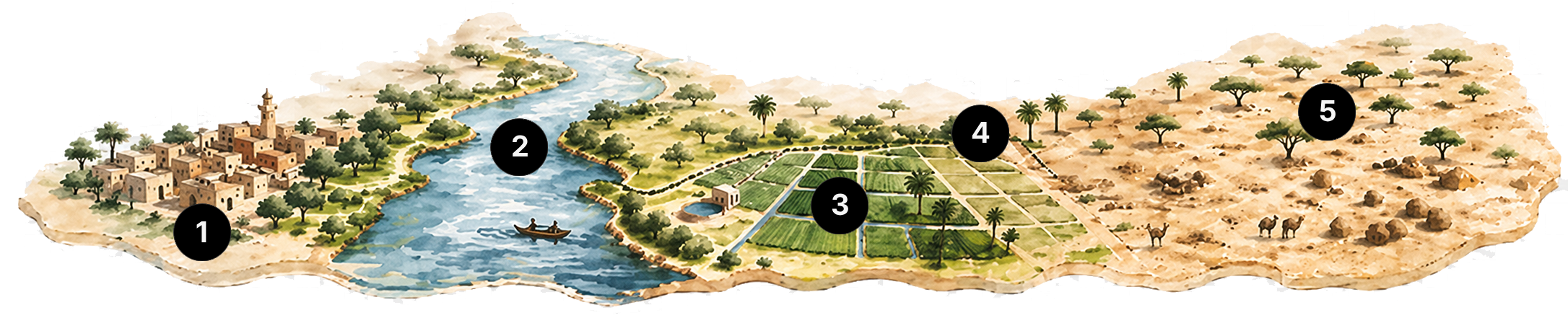
1
Podor Town
(settlement & services)
2
Senegal River
(lifeline & connectivity)
3
Irrigated market
gardening areas
(high-value production)
4
Connecting routes
& infrastructure
(access & exchange)
5
Ferlo drylands
(natural resources
& pastoral systems)
A territorial platform where land, water, communities and local resources are planned together.
From inclusion to leadership
Women are central to the Podor–Ferlo approach because they already play a decisive role in agricultural production, food processing, household resilience and local economic life.
“
Beyond inclusion
Women should not be seen only as beneficiaries of the project, but as economic operators, knowledge holders and leaders of territorial transformation.
Existing women-led dynamics
The project builds on women’s associations already active in farming, sustainable practices and food security.

Leadership
Strengthening women’s role in local decision-making and territorial transformation.

Skills & capacity
Supporting training, know-how and production capacity to create durable livelihoods.
Structured value chains
Improving access to processing, markets and local economic opportunities.
” When women lead, local resources can be transformed into stronger livelihoods and more resilient territories. “
Building the foundations for lasting change
Sustainable territorial transformation relies on effective institutions, transparent governance and strong local capacities. The Podor–Ferlo project strengthens systems, relationships and tools so that progress can endure beyond the life of the project.

01
Strengthened
institutional capacities
We support local authorities and community structures to plan, manage and coordinate natural resources and development initiatives more effectively.
02
Inclusive governance and accountability
We promote transparency, participation and accountability in decision-making to build trust and strengthen social cohesion.

03
Knowledge, data
and learning
We generate, share and use reliable data and lessons learned to guide decisions and improve policies and practices.
04
Sustainability
and long-term impact
We build local ownership, diversified financing and resilient systems to ensure that results endure and continue to grow.
Build high-integrity land restoration platforms in West Africa
The Podor–Ferlo initiative reflects LDN Advisory’s approach: transforming complex territories into structured, investable and executable land restoration platforms.
We work with local partners, institutions and investors to design projects that regenerate land, create local value and support communities over the long term.
Partner with LDN Advisory to structure land restoration projects that combine environmental integrity, territorial intelligence and inclusive economic development.